
Welcome to the Museum of Software Development.
Please keep your hands away from the exhibits.
Some of the technologies displayed here are fragile, unstable, and still somehow running production banking systems.
Today’s tour includes:
The Forum Developer → The Stack Overflow Era → The Framework Expansion → The Tutorial Boom → The Senior Developer → The AI Era → The Lost Rituals → The Developer, Unchanged.
The first exhibit awaits below.
Exhibit 01 - The Forum Developer (1998 – 2007)
Here we see one of the earliest known programmers in their natural habitat.
This was the golden age of phpBB, vBulletin, and Usenet newsgroups, where every programming question began a thread and every thread was an adventure.
Notice the environment:
- 37 open browser windows
- neon-colored forum boards with flaming banner graphics
- a desktop wallpaper featuring something dramatic
- unexplained animated GIFs used purely for emphasis
The Forum Developer survived primarily through community spirit and the occasional blunt redirect. Questions were greeted with sacred phrases such as:
"Please search before posting."
Veteran developers will recognize the uncensored version.
or the more advanced:
"Duplicate thread. Locked."
Historians believe many junior developers found their footing in this era by simply reading through thousands of archived threads. The answers were already there. You just had to page through them for forty-five minutes.
Exhibit 02 - The Stack Overflow Era (2008 – 2023)
Ah yes. The golden age of collective knowledge.
Please approach carefully.
Around 2008, Stack Overflow transformed programming help from scattered forum archaeology into organized collective suffering.
This civilization achieved unprecedented technological advancement through one revolutionary discovery:
"Someone else has already suffered before you."
The Stack Overflow developer did not solve problems in the traditional sense. Instead, they performed a sacred four-step ritual:
- Google the error message, entire thing, quotation marks included
- Click the purple link already visited three times before
- Find the accepted answer, posted in 2012
- Whisper quietly: > "Please still work."

Notice the preserved workstation. Researchers recovered:
- 14 browser tabs
- 3 abandoned side projects
- one unanswered existential question
- a coffee mug that may once have contained coffee
One fascinating behavior was their ability to identify the correct Stack Overflow answer purely by instinct, even when surrounded by:
- five conflicting solutions
- a comment war from 2015
- and a bold red warning reading "DO NOT USE IN PRODUCTION"
The experienced developer somehow always knew which one to copy. Science still cannot explain this.
By 2021, Stack Overflow had helped developers over 50 billion times. The collective suffering had become collective wisdom. And it was magnificent.
Exhibit 03 - The Framework Expansion Era (2013 – 2018)
Around 2013, the frontend ecosystem entered what historians now call:
“the era of rebuilding the same app seventeen different ways.”
Please remain calm near this exhibit.
This period was defined by rapid framework evolution and mild psychological exhaustion.
A developer could leave for vacation and return to discover:
- three new JavaScript frameworks
- two deprecated build tools
- one Medium article titled > “Why Everything You Know Is Wrong”
Simple websites now required:
- 847 npm dependencies
- Webpack configuration understood by nobody
- a package called
left-pad - TypeScript (optional, then encouraged, then spiritually mandatory)
Communities formed around competing philosophies:
- React developers believed everything should be a component.
- Angular developers believed everything should be an enterprise architecture diagram.
- Vue developers were simply trying to have a nice time until someone asked about scalability.
A framework considered revolutionary in 2014 was called “legacy” by 2017.
Archaeologists are still uncovering abandoned monorepos beneath modern frontend stacks. Each one tells a story of optimism, ambition, and a failed migration plan.
Exhibit 04 - The Tutorial Era (2015 – Present)
This room is dedicated to unfinished dreams. Please lower your voice.
Inside these glass displays are preserved GitHub repositories with names like:
netflix-clone-final-v2-REAL
startup-idea-v3
ai-app-new-new
todo-app-final-FINAL
Most contain a broken authentication flow, at least one expired API key, and a README that says simply:
"still working on it"
The Tutorial Era emerged as online learning platforms made software development accessible to millions of people worldwide. For the first time, anyone with curiosity and an internet connection could begin building real applications with remarkably little friction.
Researchers later identified a recurring developmental condition commonly referred to as:
"tutorial hell"
Symptoms included:
- completing courses with growing confidence
- struggling to begin independent projects
- repeatedly restarting the same application with newer technologies
- maintaining twelve open tabs titled: > "Build X in 20 Minutes"
Many developers believed they were one tutorial away from finally “becoming real developers.”
Curiously, this belief was not entirely incorrect.
Modern historians no longer classify the repositories in this exhibit as failures. They are now understood as early-stage artifacts of experimentation, persistence, and skill formation.
Several developers represented here later became senior engineers, though many still have a folder named final-final-v2 somewhere on their desktop.
Exhibit 05 - The Senior Developer
You may notice this exhibit appears empty.
Look closer.
There. In the corner.
The senior developer conserves energy through minimal movement and aggressive pattern recognition. Researchers believe they have witnessed the same industry trend cycle approximately four separate times under different branding.
Common phrases include:
- "Who wrote this service? Let's ask them before we touch it."
- "We tried something similar in 2016."
- "It depends."
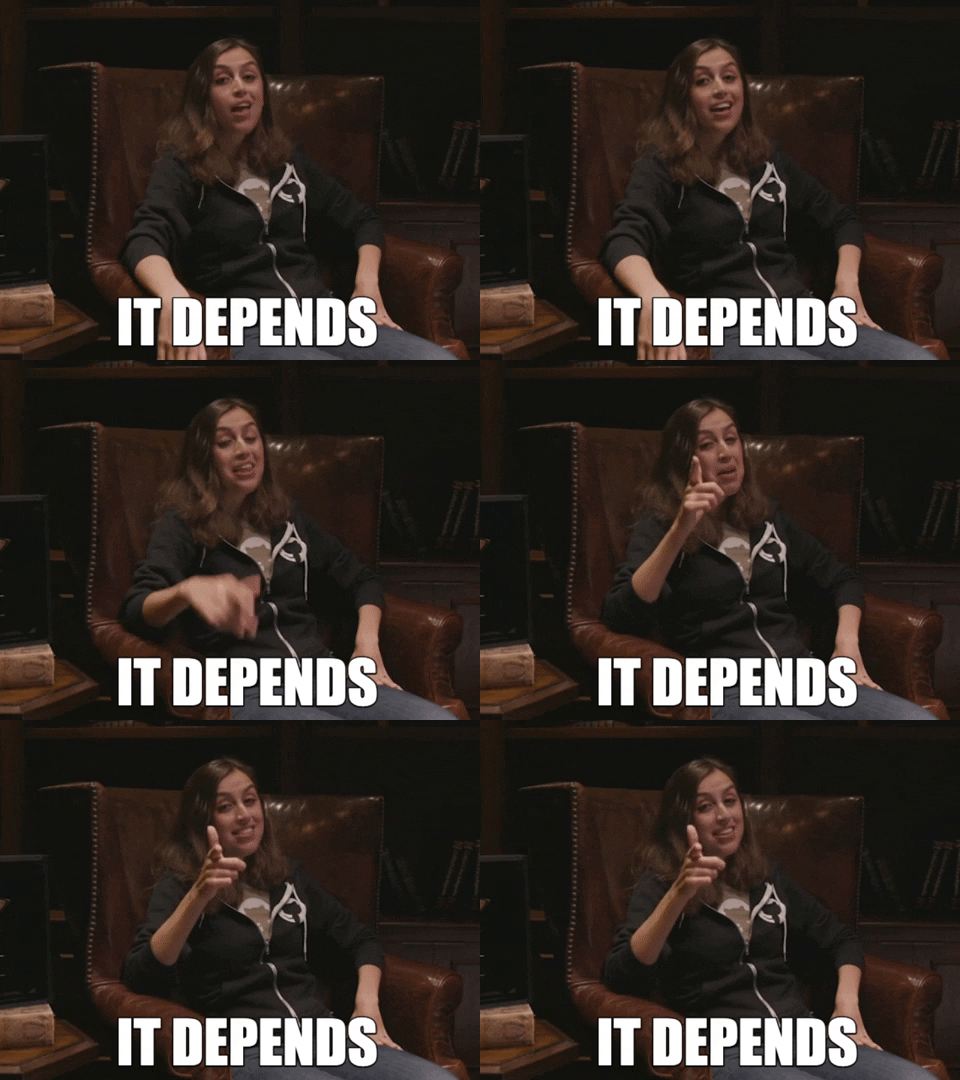
The senior developer possesses several unusual abilities:
- locating production issues by staring silently at logs
- reading stack traces faster than documentation
- deleting 4,000 lines of code without elevated heart rate
- identifying fragile infrastructure purely from file names
When introduced to a "revolutionary new JavaScript framework," the senior developer typically asks:
- How large is the bundle?
- Who maintains it?
- Will it still exist in two years?
Researchers initially misidentified this behavior as negativity.
It was later classified as experience.
Exhibit 06 - The AI Era (2022 – Present)
Please proceed carefully.
This exhibit is evolving in real time.
For decades, developers searched the internet for answers.
Then the answers started talking back.
The modern developer no longer writes code alone. An AI now sits beside them at all times: infinitely fast, endlessly confident, and occasionally catastrophically wrong.
Observe a preserved AI-assisted workflow:
Developer:
"Build me a scalable auth system with retry logic,
clean architecture, and proper error handling."

AI:
[creates something impressive and deeply suspicious]

Developer:
"Not like that."

AI:
[creates something different and equally suspicious]

Developer:
[accepts 73% of it, fixes the dangerous parts,
and ships to production]
Entire categories of work changed almost overnight.
- Boilerplate disappeared.
- Syntax memory became optional.
- Junior developers began shipping features in days that once took weeks.
A new skill emerged instead:
knowing how to explain what you actually want.
Prompt engineering. Communication. Context. Clear thinking.
Turns out these mattered more than everyone expected.
Senior developers adapted differently. Their value shifted from writing code quickly to recognizing subtle architectural mistakes before they reached production.
The experience has been described as:
“Pair programming with an infinitely confident intern who has read the entire internet.”
Entire codebases now appear overnight:
- beautifully formatted
- well documented
- occasionally solving a completely different problem than intended
The humans still review.
The humans still decide.
The humans still deploy hotfixes on Friday night.
Some traditions survive every technological revolution.
Exhibit 07 - The Lost Rituals
Many ancient practices have quietly disappeared. The museum has preserved them here for educational purposes.
- Reading Documentation. Once considered the first step. Now often attempted only after the third Stack Overflow thread and two AI prompts fail. Ironically, documentation has quietly gotten much better.
- Memorizing Syntax. Modern developers ask the AI. This is arguably fine.
- Closing Browser Tabs. Declared impossible sometime around 2017. No recovery in sight.
- The "Temporary Fix." Despite the name, several temporary fixes from 2014 are still in production today, now considered load-bearing infrastructure.
- The 2 AM Deploy. Once a beloved tradition where developers, filled with optimism and a light disregard for consequences, pushed changes to production late on a Friday. Though officially discouraged, sightings still occur in the wild.
Some rituals faded. Others simply evolved.
Final Exhibit - The Developer, Unchanged
Despite dramatic evolutionary changes across three decades, all developer generations share the same core behaviors.
Every developer, regardless of era:
- believes the current bug "should be simple"
- feels a quiet dread when asked to touch legacy code
- has deployed something unintentionally and aged visibly in that moment
- has pasted code from the internet and silently asked the universe for help
The tools changed. The languages changed. The frameworks changed. The AI arrived.
But the developer remained the same person, sitting in front of a screen at 2:13 in the morning, reading an error message, thinking some version of the same thought that every developer since 2008 has thought:
"Surely someone on the internet has suffered before me."
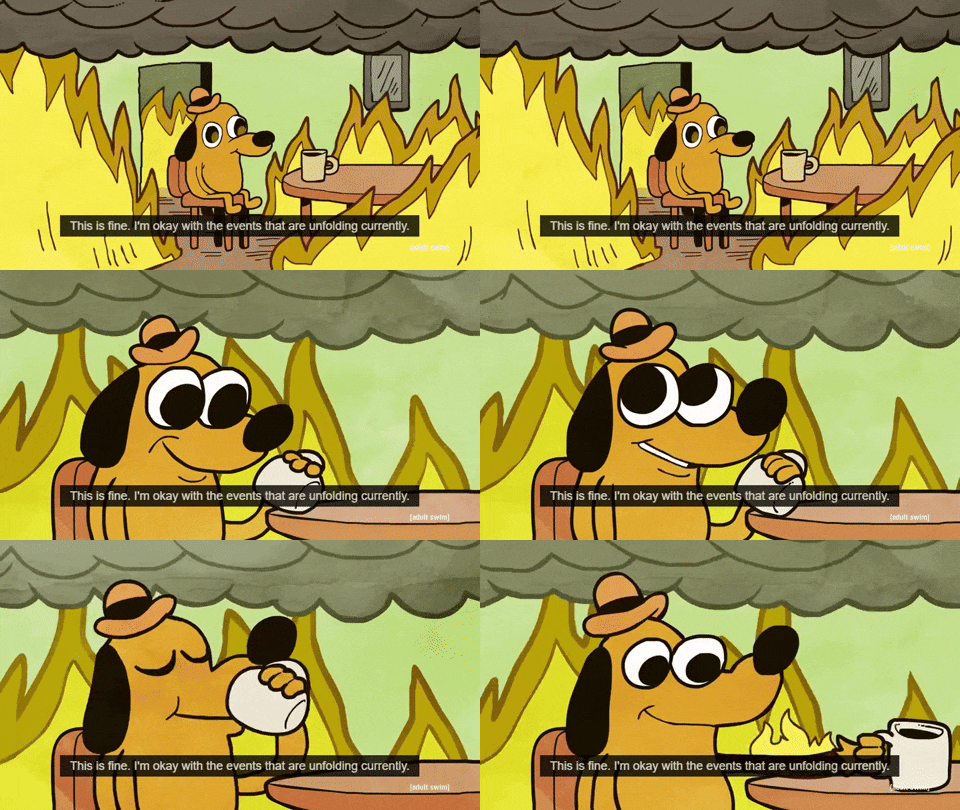
They had. They answered. It is still there, upvoted 847 times, from a thread opened in 2011.
Thank you for visiting the museum.
The gift shop sells mechanical keyboards, unfinished side projects, and a mug that says "it depends."
Which exhibit do you belong to? Drop it in the comments.
I’ll say mine in the comments first.
🤝 Stay in Touch
| Place | Find me here |
|---|---|
| GitHub | building things → hemapriya-kanagala |
| resources & updates → hemapriya-kanagala | |
| X | random dev thoughts → @KanagalaHema |